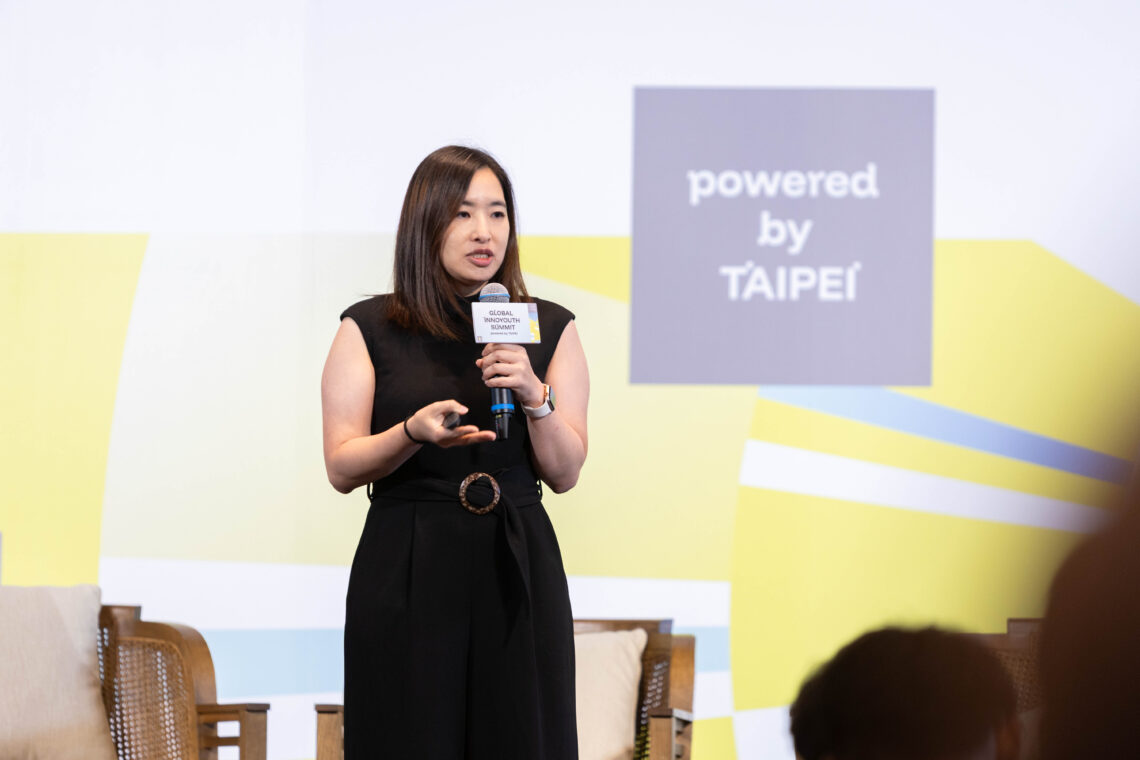
Last July, I was invited to speak at the 2025 Global InnoYouth Summit — a gathering of young innovators, entrepreneurs, social activists, and civic leaders from over 40 cities around the world, held at Regent Taipei on July 29th. The summit was organized by the Taipei City Department for Youth and brought together more than 150 participants for a full day of keynotes, panels, and workshops on global leadership, innovation, civic engagement, and the future of cities. Taipei Mayor Wan-an Chiang opened the day in person.
The speaker lineup came from all over — founders and operators from Techstars, a mission engineer from a lunar exploration company, educators, public affairs leaders, venture investors from Latin America and Southeast Asia. It was a serious international room, and I was glad to be part of it.
There’s an added layer of meaning in speaking at an event like this for me personally, because Taiwan is home. I grew up here. I went to NTU. Coming back to speak to a room of globally-minded young people — many of them international, many of them Taiwanese heading out into the world — felt like exactly the kind of conversation I’d want to have. And it pushed me to be honest rather than polished.
My talk was called “Innovate Your Dream Life — Without a Roadmap.”
Below is a fuller version of what I said — for anyone who was in the room and wants to revisit it, and for anyone who wasn’t.
There is no universal roadmap.
That’s where I started. Not as a provocation, but as something I genuinely wish someone had said to me when I was sitting where many of them were sitting.
We live in a world that is very good at producing roadmaps. Ten-step plans. Five-year frameworks. LinkedIn bios that make every career look like it was always going to turn out exactly this way. And if you’re a young person who’s already consumed your share of books and TED Talks promising to show you “the path to success” — well, you know the genre. I’ve read most of them too.
But here’s the honest truth: everyone’s definition of “making it” is different. Everyone’s journey is different. The real question — the one that actually matters — is not how you follow someone else’s map. It’s how you build a life that feels true to you, especially in a world that keeps changing underneath your feet.
What life looks like in your head — and what it actually is.
When I was younger, I thought life was linear. Do well in school. Get into a good university. Land a job. Climb the ladder. Retire. Done. If you grew up anywhere with a strong academic culture — and in that room, many people did — you probably know this script by heart. It may have been handed to you before you were old enough to question it.
And for a while, I followed it: National Taiwan University, then banking, then an MBA at MIT. On paper, I was right on track.
But life is actually messier than that. It loops. It zigzags. There are setbacks, surprises, and full restarts. Some of the pivots you choose. Others get chosen for you — by pandemics, by market shifts, by personal losses, or just by the quiet, unsettling realization that who you are at 25 is genuinely not who you’ll be at 35. I didn’t know that then. I had to find out by living it.
When that happens — and it will — you need more than a plan. You need a way to adapt.
Enter: the Lean Startup method — applied to life.
The framework I’ve found most useful, both for building companies and for building a life, comes from the startup world: the Lean Startup method.
The core idea is simple. You don’t wait until your product is perfect. You build a Minimum Viable Product — the smallest version of your idea that you can actually put into the world — and you ship it. Then you watch what happens. You measure. You learn. You rebuild.
Build → Measure → Learn → Repeat.
What if you applied that same loop to your life?
Let’s make it concrete. Say you have a dream: “I want to live a global life.” Sounds exciting. But what does that actually mean? How do you know if it’s something you truly want — or just something that sounds good when you say it out loud?
Your MVP isn’t quitting your job and moving abroad. That’s Version 10. Your Version 1.0 is smaller. It’s joining a cultural exchange club. Making a genuine friend from a different country. Taking a language class you might hate. Volunteering at an international event in your city.
Each small experiment gives you real data — about the world, and about yourself. Maybe you discover it’s not traveling you love, but connecting with different ways of thinking. Maybe you hate long flights but you’re brilliant at organizing cross-cultural events. Maybe “global” for you means working with international clients from your home city, not moving abroad at all. You only find that out by testing it.
The goal isn’t to get it right on the first try. The goal is to learn faster than someone who spent three years planning and never actually started.
Resources and constraints — designing with what you have.
Here’s where I wanted to be careful. Not everyone in that room was starting from the same place, and I knew it.
Some were navigating real financial constraints. Family expectations that carry genuine weight, not just pressure. Visa complications. The reality that certain doors open more easily depending on where you were born, what passport you hold, what your family situation looks like. That is real. And I didn’t want to paper over it with startup optimism and call it inspiration.
But I also believe this — and I’ve lived a version of it:
Constraints aren’t blockers. They’re your design boundaries.
When I wanted to study abroad and didn’t have much money, I didn’t abandon the idea. I designed around what I had. I found an exchange program that covered tuition. I took on side work to cover living costs. I refused to let “I can’t afford it” be the final word. The goal stayed the same. The path got more creative.
Resourcefulness isn’t about having more. It’s about designing better with what you actually have in front of you. Some of the most interesting paths I’ve seen came from people who had the fewest obvious advantages and were therefore forced to be more inventive about how they moved.
Constraints sharpen your thinking. They force specificity. They push you toward solutions that actually fit your real life, not some idealized version of it.
Pivoting — and why it isn’t the same as failing.
In the startup world, a pivot is when you change direction based on what the market is telling you. It’s not giving up. It’s updating your thesis with better information.
The same logic applies to a life.
Maybe your original vision shifts after a pandemic reshapes an entire industry. Maybe AI transforms the job you were training for before you’ve even entered it. Maybe you simply grow out of a goal you once held tightly — not because you failed at it, but because you changed, and the goal didn’t change with you.
Pivoting isn’t a sign you made a mistake. It’s a sign you’re paying attention. It takes more honesty to pivot than to stay the course out of stubbornness. In a world that moves as fast as this one, the ability to adapt — to stay aligned with your actual values rather than your original plan — is one of the most valuable things you can cultivate in yourself.
The people I’ve watched build genuinely interesting lives are not the ones with the best original plan. They’re the ones who stayed honest with themselves when the plan stopped fitting.
So: what’s your Version 1.0?
That’s the question I left the room with. And I’ll leave it here too.
Not your ten-year plan. Not the answer that looks impressive on an application or sounds right at a family dinner. Not the dream someone else mapped out for you. Just your next small build. The tiniest experiment you can actually put into the world — this week, this month — and genuinely learn from.
Because the dream life isn’t found. It’s built — one small experiment at a time.
The summit was covered by TVBS, and it was one of the more energizing rooms I’ve been in recently. Not because of the production or the venue — because of the people in it. Young leaders who had traveled from across the world, who asked real questions, who were thinking seriously about what comes next. Talking to people at this stage of life is something I find genuinely meaningful. It’s the age where the right conversation can actually shift something. I know because I was that age once, and I remember which conversations stayed with me.
Everything I said on that stage, I meant for that age group specifically. This is the talk I most wish someone had given me in college.
If you’re a student or a young professional reading this and something here resonated — or if you want to push back on any of it — I’d genuinely love to hear from you.
And if you’re putting together an event — a summit, a university talk, a conference, anything that brings ambitious young people together to think seriously about their futures — reach out. This is exactly the kind of work I want to keep doing.