Skip to content
← All writing

Build vs. Buy

2 articles

AI Property Management Software

COZi Build #1 · July 23, 2026

I Tried Many PMS on the Market. Here’s Why I Built My Own Instead.

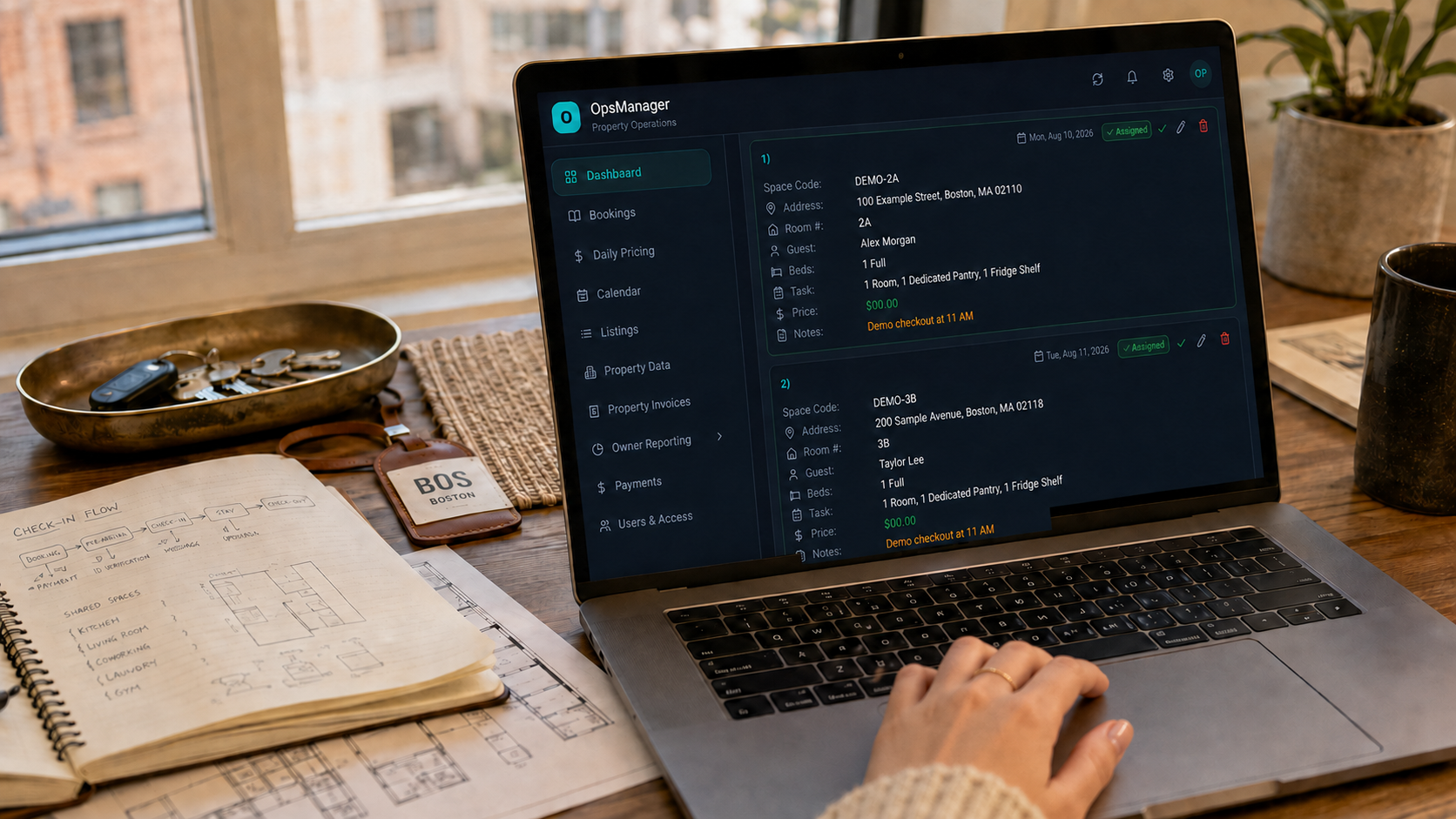
Somewhere along the way, streamlining COZi’s operations became one of my favorite parts of running it. Finding every friction point an operator hits — a cleaner who no-shows, a guest who checks in early, a payment that doesn’t reconcile — and quietly building a backup or a remedy for each one, until the whole thing runs without needing to lean on me constantly. That’s a genuinely satisfying kind of problem-solving, and I’m not going to pretend otherwise. But there’s a number every operator eventually hits where “I’ll just keep improving my own system” stops being the obvious answer, and “maybe I should get a real PMS” starts sounding reasonable. For me, that number arrived somewhere around 50 rooms. So I went and tried almost every PMS with a name you’d recognize. Here’s what I found. 1. The pricing doesn’t make sense at scale Most property management systems price per listing, typically $15–20 a month. That sounds fine until you do the math on 50 rooms: $750–1,000 a month, before you’ve automated a single thing you weren’t already doing. For $750 a month, I could hire someone in the Philippines to do everything the software does — and more, because a person can also use judgment. That comparison alone made most of these tools a hard sell before I’d even opened a demo. 2. Switching PMS is disruptive in a way the free trials don’t tell you The products themselves are, frankly, more similar than different — and the cheaper ones tend to be noticeably harder to use. But the real problem isn’t the interface. It’s what happens the moment you connect one to your OTA listings. Almost every PMS wants to take over your OTA settings the second you integrate — minimum stay rules, pricing, availability, all of it. There’s no “light” way to try one. You have to connect real, live listings to actually see how a system behaves, and if you don’t like it, disconnecting is its own project. That operational disruption is the real cost of a free trial, and it’s a big part of why I dragged my feet on this for so long even with trials sitting right there. 3. None of them are built for how I actually operate This is the one that ultimately mattered most. COZi isn’t a typical vacation rental portfolio — it’s co-living, which means bathrooms and kitchens are shared across multiple rooms. Cleaning, ideally, should be scheduled around actual occupancy, not a fixed calendar, so I’m not paying for a communal clean when half the rooms are empty. That’s an extremely specific need. It’s not a feature any general-purpose PMS is going to build, because it doesn’t apply to most of their customers — and it shouldn’t. But it’s exactly the kind of thing that’s easy to build when you’re building for one operation instead of thousands. That’s where vibe coding actually earns its place in this story. It’s not that AI makes building a PMS “easy” in some general sense — it’s that it makes building the specific, narrow thing your business actually needs viable, when no vendor was ever going to build it for you. Where this leaves me None of this is a claim that off-the-shelf PMS software is bad. For a lot of operators, the math and the fit are both fine. For COZi, at this size, with this kind of property, neither one worked — and that gap is what COZi Ops grew out of. This page will keep following that build as it happens — what’s shipped, what’s broken, and what I’d do differently with what I know now.

Read the article

I Almost Bought a SaaS Company (And I’m Glad I Didn’t)

Acquisition · March 25, 2025

I Almost Bought a SaaS Company (And I’m Glad I Didn’t)

Late last year, a warm lead slid into my inbox—a SaaS company in HR tech. I knew next to nothing about HR tech. But I know SaaS. I know tech. And I’ve always had a thing for buying a business. In my day-to-day, I’m constantly making investment decisions—whether I’m identifying the next property for my co-living business, COZi Home, or running the numbers for the new product for “Mommy Goes to Work“. Over time, I’ve developed a solid investment instinct—data-backed, gut-checked, and battle-tested. And here’s one truth I’ve learned: The juiciest opportunities often hide in the boring, dusty corners no one wants to look at—because they’re not glamorous, not trendy, and they require actual work. But that’s the point. All that unsexy, roll-up-your-sleeves kind of work? That’s what keeps the crowds out—and what quietly screams: opportunity. So when this lead came across my desk, I leaned in.   Hidden Gem or Sinking Ship? Let’s be real: the company wasn’t a rocket ship. Flat growth. Outdated tech. And it was in a vertical so niche, I had to Google acronyms I’d never heard before. But—there were paying customers. Sticky ones. Loyal, low-churn users who had been around for years. And if you’ve ever built a startup, you know just how painful it is to get people to pay for your product—let alone stick around. They’d already cleared three of the hardest hurdles: Product-market fit Procurement hell Recurring revenue that actually recurs That’s worth digging into. To me, it meant we could skip the “trial and error” phase and start building. Bring in the right team. Modernize the tech. Turn on the (currently nonexistent) marketing engine. Clean up onboarding so we could scale. If things clicked, I saw a clear path to turning it into a real business—one with a clean eight-digit exit down the line. So I dove in.   Small Deal Doesn’t Equal Less Complexity You’d think small deals move fast. Spoiler: they don’t. Here’s the timeline to give you an idea: Month 1: Intro, internal assessment, debates with my team. Months 2–3: Negotiations began and quickly turned into a slow crawl. Months 4-5: Reached the agreement with the Seller, signed LOI, and began due diligence.  Roadblock #1: Seller valuation was… optimistic. They started with wanting to please everyone—friends, family, all the previous investors and employees who chipped in. It took some time to bring the Seller back to reality. In hindsight, our final valuation was 10% of the initial ask. Understandably, the Seller wanted the best for their shareholders, but this shows how far we had to pull the expectations back to earth. Roadblock #2: Endless back-and-forth on terms. Roadblock #3: The founder mentally didn’t want to talk to her old investors. In micro-deals, money isn’t the only currency—emotions run the table. The founder had raised from people close to her. Now she had to tell them that their money was gone. Possibly forever. It wasn’t about spreadsheets—it was guilt and awkward family barbecues. That kind of emotional weight can stall a deal indefinitely. So we did something most buyers wouldn’t: We helped her brainstorm the communication strategy. We positioned our acquisition as her opportunity to finally close this chapter. We even helped her write the letter to the shareholders. Literally. It wasn’t about the deal terms—it was about helping her unload the emotional weight she’d been carrying for years.  That cracked it open. We signed the LOI.   Deal Breaker, Unexpected. After the LOI, I felt good. Due diligence was cruising. Financials? Solid. Customers? Real. Operations? Fine. In my previous M&A life, this meant we were crossing the finish line—guaranteed. Then came technical due diligence. We expected some mess. After all, we weren’t buying a startup built by MIT engineers. But we had a solid CTO and felt ready to clean things up. Until we saw what was under the hood. The codebase was… let’s call it “creative.” It wasn’t just messy—it was built on shaky foundations. To get it scalable would mean not just tuning it, but rebuilding the entire thing. That’s not a pivot—that’s a full-on rewrite. We ran the numbers. Time, cost, burn, distraction… The math didn’t work anymore. After a difficult meeting, we decided to walk. What I Took Away (Besides 100 Hours of Zoom Calls) Here’s what this experience taught me (the hard but useful way): 1. In micro-deals, the product could be the company. In traditional M&A, deals fall apart over financials, customers, or terms. But when you’re buying a business this small, you can’t ignore the product. Just because the company is generating revenue, its customers are paying, doesn’t mean it can scale. We didn’t walk away because of the unmet terms. We walked because the tech was beyond salvage. 2. Build your acquisition team early—and make it strong. Don’t wait until the LOI signed to bring in experts. We knew from day one that we’d need a tech wizard and a marketing brain. So we brought them in before we needed them. While I ran strategy and ops, my partner led product, and together we assembled an A-team to vet the deal from every angle. That team saved us. Had I gone at this solo, I probably would’ve signed, celebrated—and then been stuck rebuilding a tech stack I didn’t budget for, with no room left for error. 3. Micro deals are less efficient than you’d think. You still need to invest just as much time and brainpower—in our case, five months from first convo to final decision. Due diligence doesn’t scale down. Legal fees alone can eat up a shocking portion of the total deal value. It takes real work, real hours, and real discipline to walk away when the math doesn’t work. Do I feel discouraged by this deal falling through? Hell no. If anything, I’m more fired up than ever. Now I’m walking into the next one more prepared, more experienced, and 100% ready to drive full speed to the finish line—with the right people in the passenger seats. There are more overlooked gems out there, hiding behind clunky dashboards, neglected mailing lists, and forgotten verticals. And I can’t wait to find the next one.

Read the article