November 15, 2026
Why an Early Check-In Request Becomes an Operations Problem

If a guest just wants to get into the room a few hours early, why is "yes" often the riskier answer for the host?
This is the operator's side of The Nine-Hour Gap Between Landing and Check-In, which looked at the same problem from the traveler's side.
1. The four hours I offered
In my early days running COZi Living, I offered early check-in whenever I could. It felt like the right thing to do in a hospitality business, and it seemed cheap to give.
One guest was flying in for a work conference. Her plan was simple: land, drop her bags, change, and head straight over. I offered her a 12pm check-in, four hours ahead of our standard 4pm. Then I scheduled the cleaner and the door code around the promise I'd made her.
On her arrival day, I was in the air myself, on an airline I don't usually fly. The wifi didn't hold up the way it does on the flights I normally plan around. I couldn't sync her door code remotely, and she couldn't reach me.
When I landed, there were a lot of messages and missed calls waiting. I resynced the code right away, and the room was ready well before 4pm. It just wasn't ready by the time I'd promised her.
She changed in a restaurant restroom and dragged her suitcase into the conference. I apologized and gave her a partial refund. Her review named exactly what went wrong: the early check-in she'd booked us for, a door code that didn't work, and a host she couldn't reach.
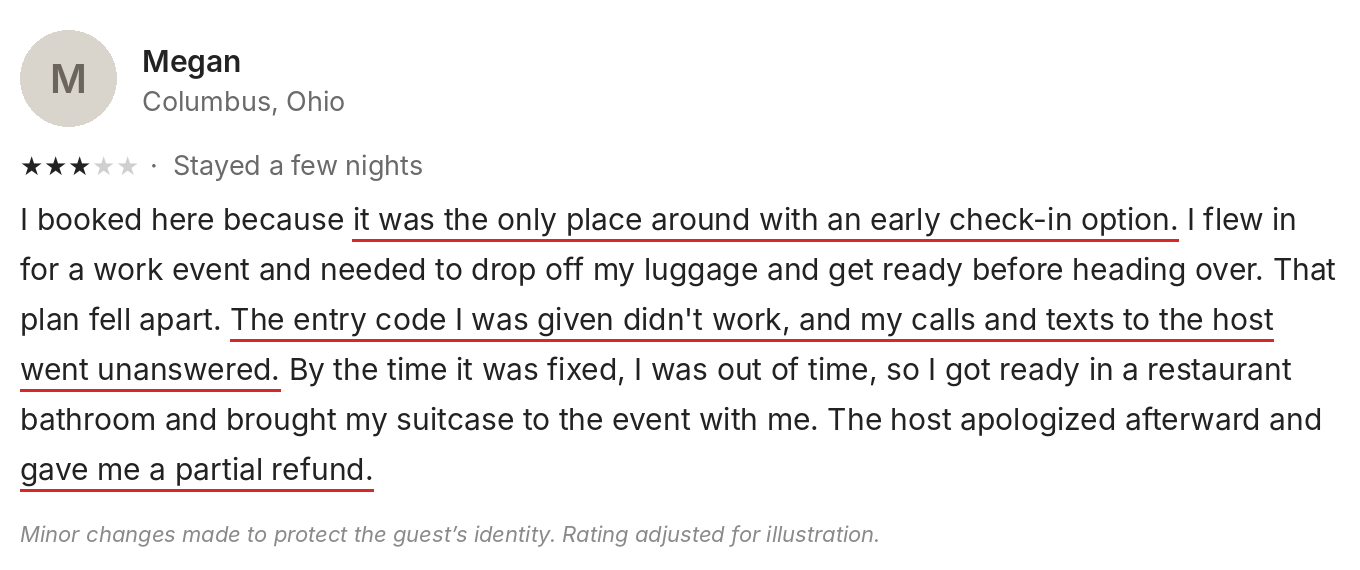
I understood her frustration. It was my mistake. I told her she could come in early, then I wasn't reachable when it mattered. But what stuck with me was the math. To make the favor possible, I'd already done extra work: rearranging the cleaning, scheduling the code early, coordinating around a window that didn't exist in our normal process. When the favor failed, I paid again, in a refund and a review. I'd delivered on the actual check-in time. The only thing that failed was the thing I volunteered.
The refund wasn't for anything in the stay she paid for. It was for a promise that only existed because I'd made it.
2. How turnover actually works
The request behind that review comes in every day, or close to it. Some version of "can I check in early" or "can I leave my bags" shows up because flight times and check-in windows were never designed to line up.
For a unit with no front desk and no storage area, an early check-in depends on several things lining up at once:
- The previous guest has left. Most checkouts are late morning, so anything before noon usually collides with when the prior guest actually walks out the door.
- The cleaner has finished. Most cleaners have packed schedules, and the real timing swings with traffic, street closures for city events, how long the unit before yours took, and the state your own unit was left in. I've never met a cleaner who can promise me 11am sharp and done by noon. They need a window.
- The door code is live. Codes are scheduled to booking times. Moving one means a manual change, and someone has to be reachable to make it.
- Someone is reachable if any of the above slips.
To a guest, cleaning is a one-hour job. To an operator, it's a five-hour turnover window. That window has buffer built in for traffic, room damage nobody mentioned, the cleaner's other jobs that day, and the occasional flat tire. That last one happens more often than you'd think. When it does, you're calling everyone you know to get a backup in before 4pm.
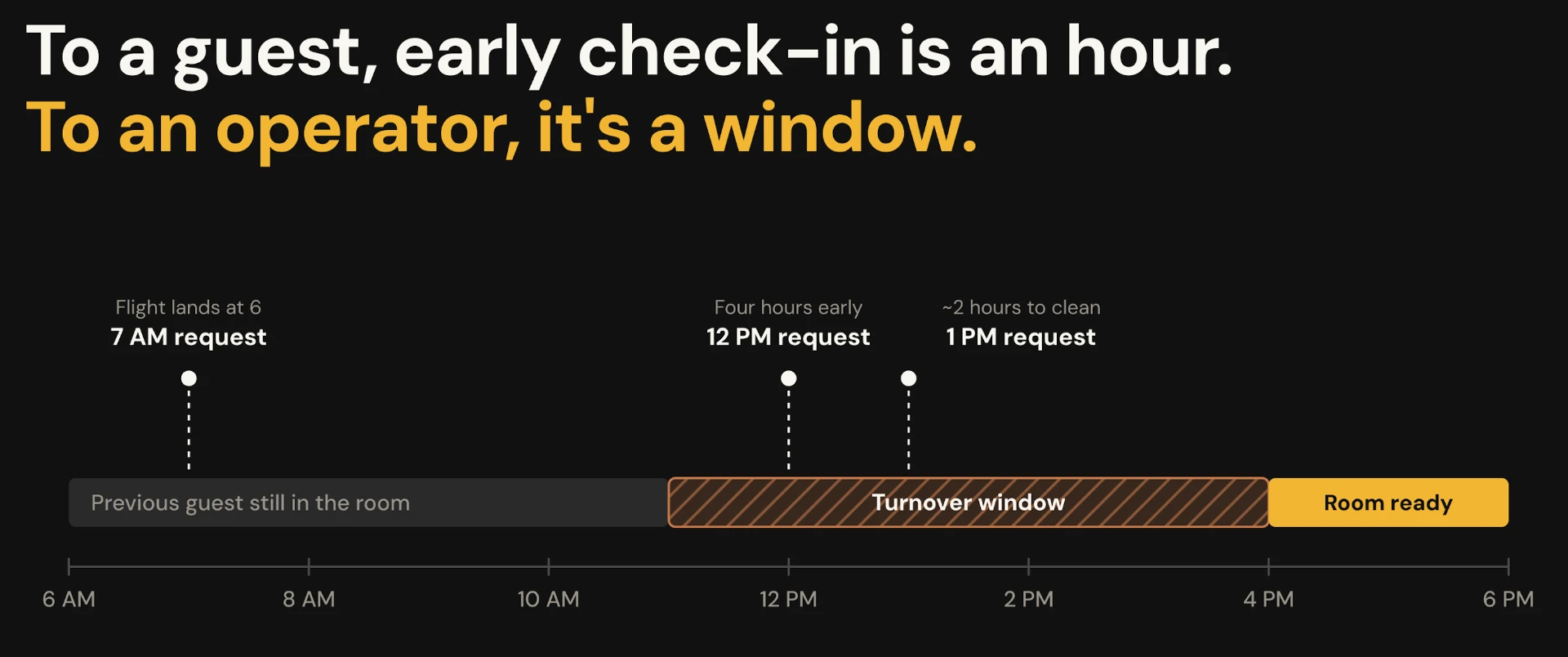
When any one of these fails, the guest doesn't experience a partial favor. They experience a broken promise.
3. What that means for an early check-in
Once you see turnover as a window rather than an hour, most early check-in requests sort themselves.
A 1pm check-in. If the previous guest checks out at 11am, that leaves roughly two hours to clean, inspect, and reset the code, with no room for error. Something in that list is very likely to slip.
A 7am check-in. Some guests ask for this because their flight lands at 6am. If the room was occupied the night before and there's nowhere on site to store bags, there's nothing to offer. The answer is no, however much I'd like it to be yes.
4. Where operators draw the line
Opening a window for early check-in is always tricky for short- and mid-term rental operators. Declining never feels good. This is hospitality, and the instinct is to accommodate.
But every exception costs something, and the cost isn't limited to one guest. A cleaner pulled forward for one unit is late to the next one. A code moved by hand is one more thing to remember on a day already full of them. Operations run on consistency: the same code timing, the same turnover schedule, the same instructions to every cleaner and vendor. Each custom arrangement adds a new way for something to break, and it can break somewhere other than the unit you were trying to help.
So the real questions are: at what cost, where's the line, and how much risk am I willing to bring into every other property to make one guest's morning easier?
For me, the answer was to stop offering early check-in as a favor. I wasn't happy with that decision, but the risk math doesn't favor the exception.
5. When there's nothing to offer
Saying no more consistently solved my problem. It didn't solve the guest's.
The 7am request is the clearest case. The room is occupied, there's no storage, and the guest has a full day ahead of them with a suitcase attached. I can be as kind as I want in how I decline, but I'm still sending them off with their luggage and no plan.
That's the moment I kept coming back to. Not the room, but the bags. If the bags had somewhere to go, most of these guests wouldn't need the room early at all.
6. Why I'm building Karri
I'd always wished a service like that existed. Hand your bags off at the airport, go start your day, and have them show up at your address later. It's the request I get daily, or close to it.
For a long time, wishing was as far as it went. Building a tech product used to mean hiring a team, building an MVP, testing the market, iterating, and coming back to build more, all before having something real enough to raise money on. The last time I went down that road, I'd spent over $100,000 while making about $100 a month, and I panicked.
Vibe coding changed that math. I had the idea, and I knew the need was real, because I'd been answering it every day. What I didn't know was how to build a product good enough to meet that need, or whether people would actually pay for it. Those were still open questions. But the cost of trying was finally low enough that I didn't hesitate.
So I opened my laptop and started writing my first line of code.